
Why Vitamin A Matters for the Skin
Vitamin A is involved in many of the skin’s biological processes. It plays an important role in cell division and the natural differentiation of skin cells. It also influences processes that are relevant to skin structure, moisture balance and elasticity.
As we age, cell renewal slows. At the same time, the skin becomes thinner, drier and less elastic. Long-term sun exposure can accelerate these changes and contribute to wrinkles, uneven pigmentation and a loss of firmness.
When used appropriately, vitamin A can support the skin’s natural renewal processes and help it appear smoother, firmer and more even.
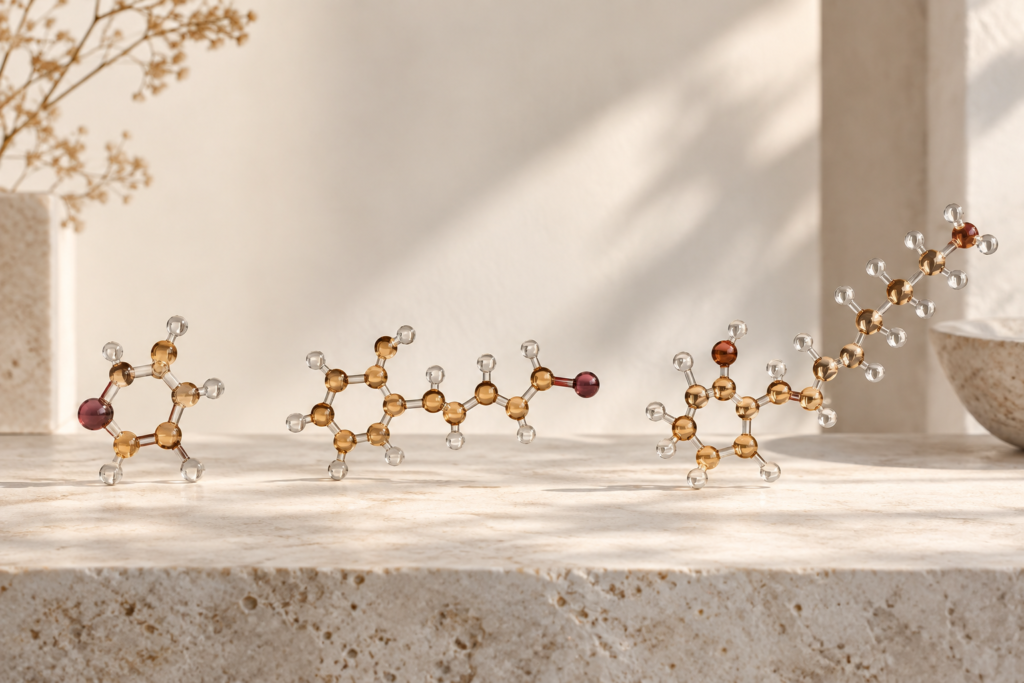
Retinoic Acid, Retinol and Retinyl Palmitate – What Is the Difference?
The term “vitamin A” covers several related substances.
Retinoic acid, also known as tretinoin, is a highly active form. It is used as a medicine in dermatology and is known for its pronounced effects. At the same time, it can cause redness, burning, dryness and irritation.
Retinol and retinyl palmitate are forms of vitamin A used in cosmetics. Retinyl palmitate is an ester of retinol and palmitic acid. It is considered particularly stable and is further processed by the skin through its natural metabolic pathways.
The challenge is that conventional retinyl palmitate is oil-soluble and can pass through the skin barrier only to a limited extent. A cream may therefore contain retinyl palmitate without making a sufficient amount of the active ingredient biologically available.
What Makes Sainte Beauté’s Water-Soluble Vitamin A Different
In Sainte Beauté creams, retinyl palmitate is formulated in a water-soluble form with the aid of a complex polysaccharide. This specialised formulation improves the distribution and availability of the active ingredient within the skin.
Studies using an artificial barrier model showed that water-soluble retinyl palmitate passed through the model membrane considerably better than a conventional retinyl palmitate formulation.
The decisive difference therefore lies not only in which vitamin A derivative a cream contains. Equally important is how the active ingredient is formulated and whether it can be made available to the skin.
Documented Changes in Skin Thickness and Elasticity
A randomised double-blind study published in 1993 compared two creams, each containing 0.2% retinyl palmitate. One contained water-soluble retinyl palmitate bound to a polysaccharide, while the other contained conventional, unbound retinyl palmitate.
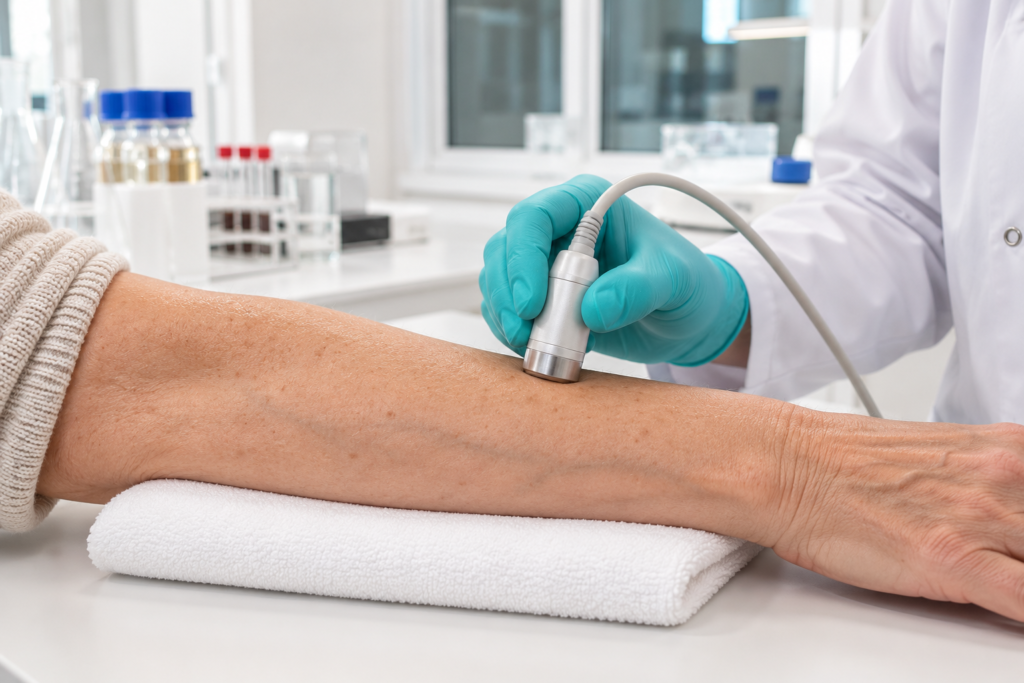
Twenty women aged 40 to 60 used both formulations for three months, applying one formulation to each forearm. Skin thickness was measured by ultrasound, while elasticity was assessed with a specially developed instrument.
After three months, the skin treated with water-soluble retinyl palmitate showed, under the conditions of the study:
an average increase in measured skin thickness of 31%
an average improvement in skin elasticity of 18%
a perceptible improvement in smoothness and radiance
The changes were statistically significant. By contrast, the conventional retinyl palmitate formulation produced no significant changes in skin thickness or elasticity.
The result underlines that formulation and active-ingredient availability are essential to cosmetic efficacy.
Comparable Results – with Better Tolerability
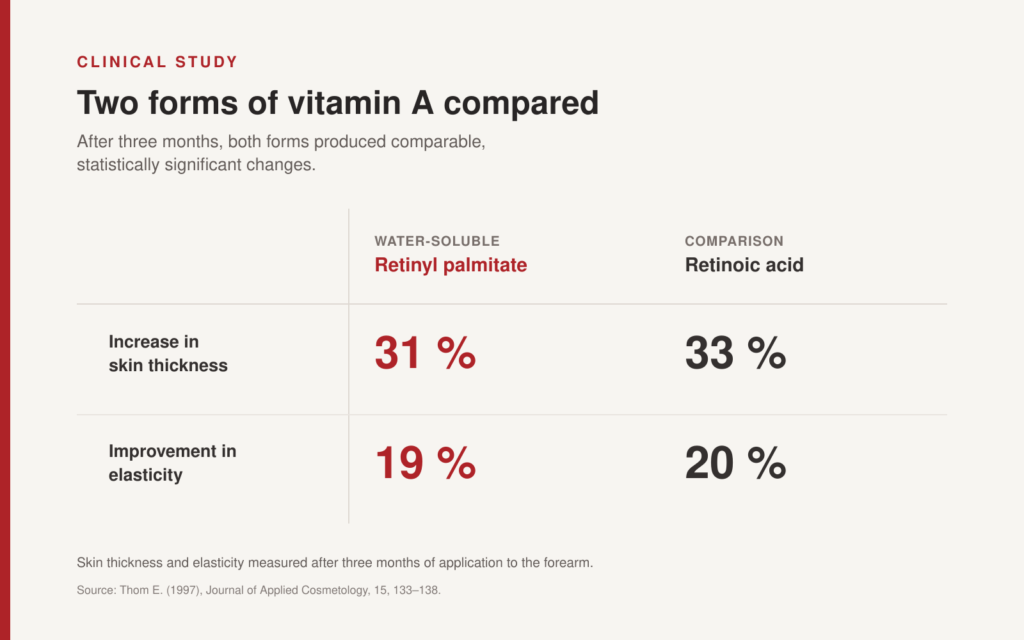
A further randomised double-blind study from 1997 compared water-soluble retinyl palmitate with retinoic acid. Twenty women aged 40 to 60 also participated in this study. The two formulations were applied to one forearm each for three months.
Both forms of vitamin A produced comparable, statistically significant changes.
The essential difference was tolerability. Seven participants reported skin sensitivity with the retinoic-acid formulation, and two of them also experienced pronounced temporary redness. With the water-soluble retinyl palmitate formulation, one participant reported redness.
In the final overall assessment, 13 of the 20 women preferred the cream containing water-soluble retinyl palmitate. Four preferred the retinoic-acid cream, while three expressed no preference.
The study therefore indicates that water-soluble retinyl palmitate can produce measurable changes in skin structure while being considerably gentler on the skin than retinoic acid.
Visible Skin Improvement Takes Time
Vitamin A is not an ingredient designed to create a short-lived surface effect. It supports biological processes that develop gradually.
In clinical studies of creams developed by Pedersen’s Laboratorium, initial changes were measured after only a few weeks, while the more pronounced results appeared after two to three months of consistent use.
A long-term follow-up also found that some of the improvements in skin thickness and elasticity achieved after three months were still measurable twelve months after treatment had ended. However, most of the effect gradually diminished without continued use.
Consistency is therefore essential. A regular skincare routine gives the skin time to respond to the active ingredient and supports its natural renewal processes.

Science as the Foundation of Sophisticated Skincare
For Sainte Beauté, luxurious skincare is about more than a pleasing texture or an elegant sensory experience. It begins with selecting documented active ingredients and creating formulations that make their potential available to the skin.
Water-soluble vitamin A combines decades of Scandinavian research with high cosmetic tolerability. It was developed for mature and demanding skin that should not be treated aggressively, but supported purposefully in its natural regeneration.
The result is intelligent skincare with a scientific foundation – for skin that can appear smoother, more elastic and visibly strengthened.

References
Thom E. (1993): Skin treatment with two different galenical formulations of retinyl palmitate in humans. Journal of Applied Cosmetology, 11, 71–76.
Thom E. (1994): Long-term effects after topical application of active retinyl palmitate. Journal of Applied Cosmetology, 12, 25–30.
Thom E. (1997): A comparative double-blind within-subject study of the efficacy and tolerability of two different derivatives of Vitamin A on skin thickness and elasticity: Retinoic acid and conjugated retinyl palmitate. Journal of Applied Cosmetology, 15, 133–138.
Wadstein J. (1993): Penetration of Different Retinoid Formulations in a Model Barrier System (Franz Diffusion Cell). Abstract presented at the Nordic Symposium “Focus on the Anti-Aging Treatment of the Skin”, Oslo.